Proven to Build Character: Character Playbook Earns
CASEL Recognition
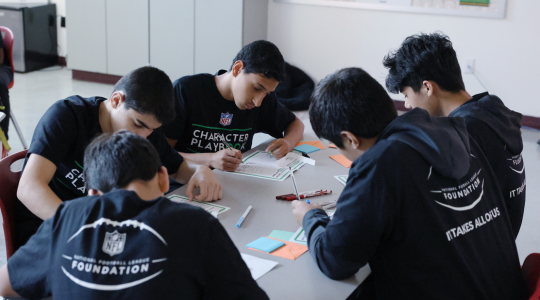
Middle school can be a very difficult time for adolescents facing new social challenges: friendship drama, peer pressure, big emotions, quick decisions that may have lasting consequences. Most students are navigating these obstacles for the first time with very little idea how to handle them. Maybe they find themselves in a situation where everyone in a group is criticizing another person’s social media post and while they feel uncomfortable, they don’t want to be ostracized. Now they have a choice: Do they ignore the behavior? Join the group? Stand up for the individual being targeted? Decisions like this can happen dozens of times in any given week at school, and they usually happen in seconds without anyone having a plan for how they are going to react.
To help students with these tumultuous tasks, Everfi partnered with the NFL Foundation in 2016 to build the Character Playbook course and teach young teens the skills and strategies for managing their emotions and dealing with social challenges in a healthy way. Following a successful efficacy study of the digital education curriculum, Character Playbook has been designated as a “Promising” program by the Collaborative for Academic, Social and Emotional Learning (CASEL) and is now included in their recommended list of evidence-based interventions for educators.
Where Students Are Starting
Social-emotional learning (SEL) remains a priority to parents and educators as rates of anxiety, depression, and other mental challenges continue to rise among teens and young adults. Baseline data collected from the course makes it clear that the need for this type of education is very real. In their pre-course test of social emotional knowledge, students only answered 61% of the questions correctly, on average. More than half of the students told us they “felt confident” in their social and emotional skills, but that was not correlated with higher pre-test scores. Notably, male students were more likely to feel confident than their female peers but scored lower on their pre-test of knowledge.
Before starting the Character Playbook course, only half of our students said that they regularly thought about the consequences of their actions before they made a decision. Two-thirds of all students agreed that “managing their emotions and relationships with peers was hard” before the course and only 37% felt that “building healthy relationships was easy.” These are essential skills for healthy adolescent development, and many teens are uniquely aware of where they are lacking.
What We Studied
As part of the application for inclusion in CASEL’s Program Guide for SEL curriculum, Everfi and the NFL Foundation conducted a rigorous study on the efficacy of the Character Playbook course in Fall of 2025. Teachers were enlisted from middle and high schools in Georgia, South Carolina, and Wisconsin to participate in the research and agreed to administer the course to one classroom of students while simultaneously not providing the content to another classroom. However, students from both classrooms were measured on their social-emotional knowledge, attitudes, and behaviors (KABs) on the same timeline so that the two groups could be compared at the completion of the study.
In this way, any differences found between those classrooms could then be attributed to the impact of the learning experience. This is a more valid test of efficacy than a simple pre-post measurement design where changes in KABs could simply be due to the natural development of the students. There was no researcher intervention in any of the classrooms so that the impact of the course and the findings of the study would reflect the real-world experience of implementing the digital curriculum in the average school week of a busy teacher.
Read the full efficacy study here.
What Changed for Students
The final sample used for analysis included pre- and post-course KAB measurements for over 220 students and was demographically representative of middle and high school students in the U.S. Compared to their peers who were measured in the same way and at the same time, students who took Character Playbook showed greater KAB improvements than students who received no intervention.
1. They have the language to name what they feel
Students knew more about social-emotional skills as their knowledge test scores increased 29% from 58 before the course to 75 after the course. This is an important foundation as research suggests attitudes and behaviors can only be impacted after basic knowledge of a topic is gained. It’s also critical that students have the basic language to understand and describe their feelings in order to communicate effectively with others.
2. They think before they act
Students increased their responsible decision-making skills as they were more likely to think before acting after taking the course. Pausing for self-reflection before acting is an essential step when making behavioral decisions, especially when emotions are high and social consequences can be dire and long-lasting. Thinking before speaking, acting, posting, texting, etc. can save relationships and help with emotional regulation.
3. They feel more confident building healthy relationships
Character Playbook students significantly increased their confidence in building healthy relationships compared to the students in the comparison group. Adolescence is a time when peer relationships feel more important than ever before, but strong connections require work to establish and maintain. To start or improve their relationships, first teens need to feel confident in their ability to do so.
4. They’re better prepared for hard moments
The course was shown to increase students’ confidence in managing both their emotions and their relationships. Middle and high school students will constantly be managing stress, dealing with peer pressure, managing interpersonal conflict, and moderating their behavioral reactions to their emotions. Character Playbook has shown that it makes students more prepared to tackle these inevitable and important obstacles as they arise.
5. Starting early makes a bigger difference
Compared to high school students, middle schoolers showed a larger gain in their confidence in managing relationships, which suggests early exposure to SEL matters and this ties naturally with Character Playbook’s recommended audience of grades 6-9.
What This Means for Teachers
Character Playbook is now an evidence-based resource for social and emotional learning and is included in CASEL’s guide for effective programs. It is available to schools and teachers at no cost and is easily administered to students through Everfi’s digital platform in just five short lessons designed to cover all of CASEL’s core competencies. The course can easily be included in a variety of classes such as advisory, homeroom, health, PE, counseling, or any morning meeting guide and comes with lesson guides and supplemental activities, so minimal prep is needed by the instructor. The content is aligned to educational standards established by CASEL, the National Health Education Standards (NHES), and the Common Core, and the program includes built-in assessments for each lesson so that teachers can track their student’s progress and performance.
A Team Effort with the NFL Foundation
The NFL Foundation sponsored both the development of this Character Playbook and this study into its efficacy, which reflects their commitment to building students’ character and maintaining their mental wellness. Since its inception, Character Playbook has reached over 3 million students in more than 22,000 schools across the country. Students and teachers consistently report that the content is engaging, and the experience is enjoyable.
In 2023, Everfi expanded Character Playbook through a partnership with the National Medal of Honor Museum Foundation, adding three videos focused on the Medal of Honor values of courage, commitment, and integrity. Integrated directly into the course, the videos build on Character Playbook’s social-emotional learning lessons and help students explore how these values can guide their own decisions and choices.
Along with providing the Character Playbook course, Everfi and the NFL Foundation have hosted over 350 in-person events with NFL teams. These exciting events not only engage students in a unique way but help to bring the SEL lessons to life in a fun and personal experience. This is what it looks like when an organization invests in education that can be implemented at scale and measured rigorously in its impact.
The Next Play
Everfi holds all its educational programs to a high standard in their design, development, implementation, and measurement. But it is a great honor to know that Character Playbook now meets the standards set by one of the most prestigious organizations for the evaluation of SEL curriculum in CASEL.
Our journey in developing quality SEL content and evaluating its impact is not over yet. Character Playbook is only one course, and lifelong social-emotional development requires consistent education and intervention that starts with foundational content and increasingly adds in complexity and nuance. Character isn’t something students either have or don’t. It’s a set of skills they can learn and practice, and the earlier they start, the better. Research will continue into future development of additional courses to supplement Character Playbook and introduce new topics throughout the K-12 curriculum. We are also committed to continuing to evaluate our programs, their impact, and how long our KAB results persist for after course completion. At Everfi, we are passionately committed to building what teachers want, what students need, and measuring what matters.
Get in the Game:
- Organizations: Learn how to sponsor education like this in your community