10 College and Career Readiness Activities to Add to Your Classroom Routine
10 College and Career Readiness Activities to Add to Your Classroom Routine
College and career readiness activities are no longer just a nice-to-have element of a high-quality education — they’re a crucial part of preparing students for the future. As expectations in both college and the workforce continue to evolve, students need structured opportunities to explore careers, practice real-world skills, and plan for life after graduation. Last year, more than 420,000 students learned critical workforce readiness skills with Everfi, demonstrating both the demand for and the impact of engaging career education. This guide breaks down practical strategies, examples, and free resources to help educators integrate meaningful experiences into everyday instruction.
Main Takeaways
- College and career readiness activities build communication, financial literacy, and decision-making skills students need for life after high school.
- Readiness instruction supports equity by giving all students access to future-planning tools and exposure to diverse career pathways.
- Everfi’s free digital lessons — including Keys to Your Future and Endeavor — show average learning gains of 29%.
- Schools can easily embed college readiness skills and instruction into core subjects, advisory time, and project-based learning.
- Teachers can begin with a single activity, then scale their planning using Everfi’s free educator resources.
Table of Contents
- Why Is Teaching College and Career Readiness Important?
- What Are College and Career Readiness Activities?
- 10 Examples of College and Career Readiness Activities
- How to Integrate CCR Into Your Existing Curriculum
- Best Free Resources for College and Career Readiness
- How to Measure the Impact of CCR
- How to Get Started With College and Career Readiness Activities Today
Why Is Teaching College and Career Readiness Important?
Students today face more choices — and uncertainty — than ever before. Employers and colleges expect graduates to come equipped with transferable skills like communication, teamwork, creative problem-solving, and financial literacy. Readiness instruction helps students understand those expectations early, learning how their interests and strengths may connect to future opportunities. Currently, many schools are missing the mark when it comes to preparing students for life after graduation. According to the U.S. Chamber of Commerce, 80% of hiring managers agree that today’s high school graduates are less prepared to enter the workforce than those in previous generations.
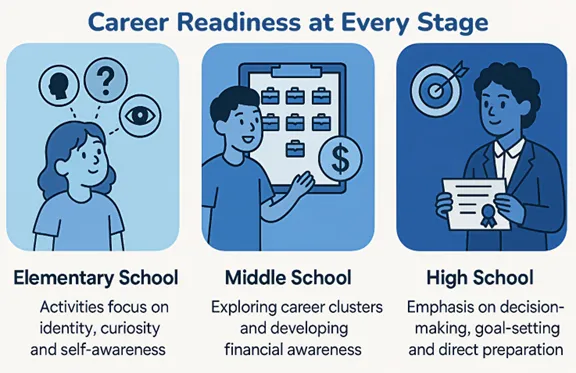
Research suggests that the ideal time to introduce future-planning concepts is late elementary school, where activities focus on identity, curiosity, and self-awareness. In middle school, students can begin exploring career clusters. This is also an ideal time to start developing financial awareness and begin connecting interests to high school pathways. At the high school level, the emphasis shifts to decision-making, goal-setting, and direct preparation through college planning, interviewing, and real-world simulations.
Sadly, many students don’t get the chance to experience college and career readiness as part of their education. Access to these experiences often depends on zip code, funding, and/or staffing. Free digital materials from Everfi can help to bridge that gap by offering standards-aligned content to students everywhere.
Courses like Keys to Your Future: College & Career Readiness and Endeavor: STEM Career Exploration deliver measurable results, including an average 29% learning gain. A total of 52% of Endeavor students report increased interest in STEM careers, demonstrating that these experiences can shape students’ futures.
What Are College and Career Readiness Activities?
College and career readiness activities are intentional learning experiences designed to help students build skills for life after high school graduation. They include everything from career surveys and resume practice to financial literacy simulations and project-based research. Beyond exposure to different pathways, these activities teach students how to set goals, evaluate options, and communicate professionally.
Many districts incorporate college and career readiness expectations into state standards and/or graduation requirements — particularly around employability, financial literacy, and career exploration. This makes CCR instruction a natural fit for core subjects, advisory periods, and interdisciplinary projects.
Everfi supports this work with a full library of free, turnkey digital lessons. Each lesson is aligned to state standards, self-paced, and built with real-world scenarios designed to spark engagement and deepen understanding.
10 Examples of College and Career Readiness Activities
Below are ten practical, age-adaptable activities you can implement in your school or classroom right away.
1. Career Interest Surveys
Students reflect on their strengths, values, and preferences as they learn vocabulary and career clusters. These surveys help students connect classroom learning to future goals, inspiring new areas of curiosity.
2. Resume Writing
Students learn how to highlight transferable skills, project experience, and community involvement — valuable for internships, jobs, college applications, or scholarship opportunities. This can also build confidence in self-expression.
3. Cover Letters
Writing cover letters allows students to practice persuasive writing and self-advocacy. You can pair this with peer review, teacher feedback, and a workshop on tone and professionalism.
4. Mock Interviews
Mock interviews — live or recorded — give students a safe space to practice communication and body language. This activity pairs well with lessons about professionalism and soft skills.
5. Postsecondary Research Projects
Students explore colleges, trade programs, military pathways, or apprenticeships. They compare admissions requirements, student experience, and cost, then present their findings and reflect on which opportunity is the best fit for their needs and goals.

6. Budgeting Simulations
Provide students with a salary and a list of expenses, then have them create a realistic monthly budget. Everfi’s Financial Literacy course offers interactive simulations and has resulted in 20% more students feeling prepared to understand their take-home pay.
7. Goal-Setting Frameworks
Students outline both short- and long-term goals, identify barriers, and develop strategies. This works exceptionally well during advisory or at the start of a semester.
8. Digital Learning with Everfi
Everfi courses — including Keys to Your Future, Endeavor, Pathways: Financing Higher Education, and the Career Development Toolkit — offer self-paced options that require no prep and include automatic grading and reporting.
9. Job Shadowing/Virtual Career Tours
Virtual tours can expose students to a variety of industries without leaving the classroom. Consider pairing this with career journaling or reflection activities.
10. Skill Stations
Set up stations around the room where students rotate through microtasks such as financial decision-making, time management challenges, or career card sorting. Quick activity changes keep engagement high while reinforcing multiple CCR concepts in one lesson.
How Can I Integrate College and Career Readiness Into My Existing Curriculum?
The most straightforward approach is to embed readiness skills into what you already teach. English teachers can incorporate resume writing into a business writing unit. In math, students can analyze salary data, compare interest rates, or explore compound interest. Social studies teachers can connect labor markets to historical movements or policy changes.
If your schedule includes advisory, homeroom, flex periods, or college/career days, those blocks are ideal for readiness lessons without sacrificing academic time.
Everfi’s courses are designed to support integration without adding planning time. Each lesson includes built-in assessments, reporting dashboards, and classroom extension ideas. Educators can access all resources through the Everfi educator portal and toolkit.
What Are the Best Free Resources for College and Career Readiness?
There are several free resources to help with college and career readiness. Here are a few.
Everfi’s College & Career Readiness Resources
Everfi offers a robust library of free digital resources covering career exploration, financial literacy, employability, and postsecondary planning. Designed for grades K-12, these courses require no prep and include downloadable lesson plans and reporting tools for tracking progress.
CareerOneStop
Run by the U.S. Department of Labor, CareerOneStop includes videos, salary data, and job outlook tools students can use to research nearly any occupation. It’s beneficial for career exploration activities and projects.
College Navigator
This tool helps students compare colleges based on cost, majors, test score ranges, retention, and graduation rates. It supports informed decision-making, especially for first-generation college students.
State CTE or Workforce Development Resources
Many state departments of education offer free resources aligned to high-demand careers, complete with frameworks, lesson banks, and employability standards.
How Do I Measure the Impact of College and Career Readiness Activities?
Tracking growth helps both teachers and students understand what’s working and where deeper support is needed.
You can start with:
- Reflection journals and exit tickets
- Student portfolios, including resumes, budgets, and personal statements
- Pre and post-assessments to measure knowledge and confidence
- Feedback surveys to help teachers refine instruction
- Everfi’s reporting dashboards, which automatically capture completion rates and learning gains
These measures help document readiness for growth for administrators, families, and students themselves.
How Can I Get Started With College and Career Readiness Activities Today?
To bring college and career readiness skills and activities into your classroom without feeling overwhelmed, try this simple approach:
- Pick one priority — career exploration, future planning, or financial literacy.
- Choose one activity or digital lesson to start with.
- Set simple goals and gather student reflections or feedback.
- Use this information to choose next steps, based on interest, timing, and standards.
- Explore Everfi’s educator toolkit to access free courses, lesson plans, and reporting tools.
The key is to start small, stay consistent, and give students plenty of opportunities to explore who they are and who they want to become.
If you’re ready to support your students as they prepare for success after graduation, Everfi is here to help. Click here to learn more and access our educator portal. Explore Everfi’s career development toolkit to give your students what they’ll need to succeed in the years to come.
Free for K-12 Educators
Thanks to partners, we provide our digital platform, training, and support at no cost.
See why 45k+ teachers were active on Everfi digital resources last school year.
Share 4 weeks of free resources with these teacher toolkits:
Amanda Berkey is a Pennsylvania-based writer and reporter with an M.S.Ed. in School and Mental Health Counseling. With 17 years of experience in education, she has taken on diverse roles in teaching, coaching, and administration.